
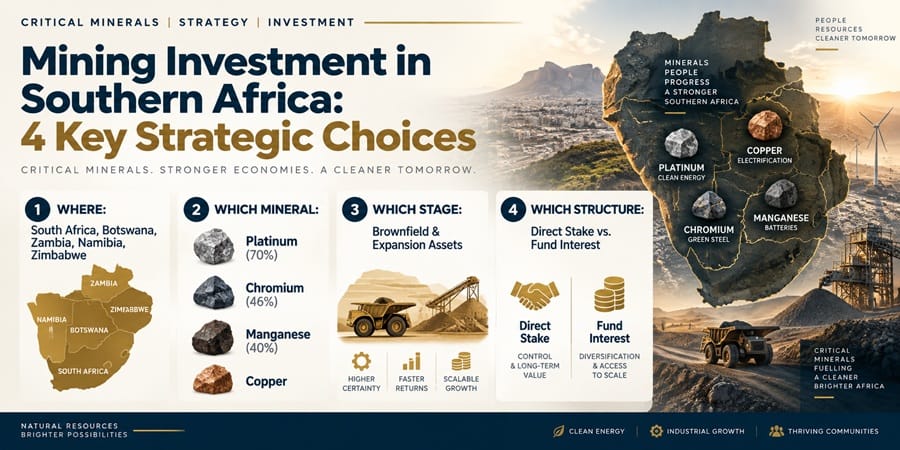
In short: Mining investment in Southern Africa gives industrial companies access to minerals the energy transition, steel and the auto industry depend on. South Africa alone mined an estimated 70% of the world’s platinum, 46% of its chromium and 40% of its manganese in 2024. Your risk and return will depend less on the commodity price on signing day than on four choices:
- Where: South Africa, Botswana, Zambia, Namibia and Zimbabwe each have their own minerals, local ownership rules and processing requirements.
- Which mineral: copper, manganese and chrome fit naturally with steel, cable and electrical manufacturing.
- Which stage: for a first entry, brownfield and expansion-stage assets usually offer the best balance of risk and value.
- Which structure: a direct stake gives control and supply; a fund interest gives exposure with less capital and expertise.
Southern Africa holds a large share of the minerals that the energy transition, steel and the auto industry cannot do without. In 2024, South Africa alone mined an estimated 70% of the world’s platinum, 46% of its chromium and 40% of its manganese, according to the US Geological Survey (USGS). [1] Namibia is the world’s third-largest uranium producer, Zambia is pushing to triple copper output, and Zimbabwe is Africa’s largest lithium producer. [16] [12] [19]
For industrial companies, in Türkiye and elsewhere, that want to secure raw materials, diversify supply away from a single dominant source, or invest for long-term returns, the region is hard to ignore. But mining is not one decision. Where you invest, which mineral, at what stage of a mine’s life and through which structure will decide your risk and your return far more than the commodity price on the day you sign.
Is Southern Africa a safer mining bet than it looks?
Southern Africa is a safer mining destination than its reputation suggests, because the world’s largest mining companies are still committing capital there. Mining runs on perception as much as geology. Executive surveys capture how a market feels from a boardroom abroad; the capital decisions of the biggest mining houses show how it actually performs. On that measure, the facts speak clearly.
- The majors are investing. Anglo American is spending R11.2 billion on an iron-ore project at Kumba’s Sishen mine. [3] Speaking in October 2026, CEO Duncan Wanblad said that despite the volatility, “the opportunity remains huge for us”. [4] Rio Tinto has approved about R8.5 billion (USD 473 million) to develop the Zulti South mineral sands deposit at Richards Bay Minerals, [5] and BHP chose South Africa to host its biggest-ever Xplor exploration bootcamp. [6]
- Mining is the backbone of the economy. South African mining contributed R477 billion to GDP in 2025, exported R816 billion of minerals, paid R124 billion in taxes and employs around 470,000 people, according to the Minerals Council South Africa. [7]
- Returns to the state are rising. Mineral royalties raised about USD 584 million between April and August 2026, more than triple the same period a year earlier. [2]
- The macro picture has improved. South Africa’s removal from the FATF grey list and improved sovereign credit ratings have strengthened investor confidence. [4]
- The region ranks well. In the Fraser Institute’s 2025 survey of mining executives, Botswana and Zambia were both among Africa’s three most attractive mining jurisdictions, with Zambia 25th of 68 worldwide. [9] [10]
- The ecosystem already exists. Johannesburg is home to the JSE, specialist mining banks, law firms, engineering houses, laboratories and contractors serving the whole region. Few markets anywhere can match that depth.
How do local ownership rules work in Southern African mining?
Every major Southern African mining country requires some form of local participation, and each one sets its rules out in law or published policy. Requiring local participation in mining is normal worldwide. What matters to an investor is whether the rules are clear and stable enough to plan around.
- South Africa: local ownership requirements are set out in the Mining Charter, and a new digital mining cadastre is being rolled out to speed up licensing. Minerals Council president Paul Dunne has urged that it be delivered “effectively, rapidly and transparently”. [7] [8]
- Botswana: since October 2025, if the state does not take its option on a new mine, a 24% stake is offered to local citizens. [11]
- Zambia: a new Geological and Minerals Development Act (2025) supports a national strategy to reach 3 million tonnes of copper a year by 2031. [12]
- Namibia and Zimbabwe: both require critical minerals such as lithium to be processed in-country. We see this as an opportunity, not a barrier. [14] [17]
Southern African mining countries at a glance
The table below summarises, for each country, the minerals covered in this article and the rule an investor should check first.
| Country | Key minerals in this article | Rule to check first | Investor signal |
|---|---|---|---|
| South Africa | Platinum group metals, manganese, chrome, vanadium, iron ore | Local ownership under the Mining Charter | Anglo American and Rio Tinto committing new capital; BHP’s biggest-ever Xplor bootcamp |
| Botswana | Copper | 24% stake offered to citizens if the state does not take its option (since October 2025) | Among Africa’s three most attractive jurisdictions (Fraser 2025) |
| Zambia | Copper | Geological and Minerals Development Act (2025) | Target of 3 million tonnes of copper a year by 2031; 25th of 68 worldwide (Fraser 2025) |
| Namibia | Uranium, lithium | Export ban on unprocessed lithium, cobalt, manganese, graphite and rare earths (2023) | World’s third-largest uranium producer; raw materials agreement with the EU |
| Zimbabwe | Lithium, chrome, platinum group metals | Raw lithium ore export ban (2022); exports of all raw minerals and lithium concentrate suspended (February 2026) | Africa’s largest lithium producer; lithium sulphate plants under development |
What do Zimbabwe’s and Namibia’s lithium processing rules mean for investors?
Zimbabwe and Namibia no longer allow lithium to leave the country as raw ore, so any lithium investment there now needs a local processing plan. Zimbabwe banned raw lithium ore exports in 2022 and, in February 2026, suspended exports of all raw minerals and lithium concentrate. [17] Namibia banned exports of unprocessed lithium, cobalt, manganese, graphite and rare earths in 2023, under its 2021–2030 Mineral Beneficiation Strategy. [14] Some foreign investors see these rules as a risk. We see them as the right policy, and a commercial opportunity for the right partner.
For more than a century, Southern Africa exported raw ore and bought back finished goods at many times the price. Processing at home is how the region keeps more of that value, creates skilled jobs and builds industry. That is not resource nationalism; it is development.
It also works in an international partner’s favour:
- Policy alignment means lower risk. A project that processes locally has the government’s goals on its side. That protects your licence and your investment far better than any contract clause.
- You ship value, not rock. Standard spodumene concentrate contains only about 6% lithium oxide, so most of every tonne exported is waste. [20] Processing in-country cuts freight costs and lifts the value of each shipment.
- Buyers want new supply chains. Battery and automotive manufacturers in Europe and elsewhere are actively seeking sources outside today’s dominant processing hubs. Namibia has already signed an agreement with the European Union on raw material supply. [15]
- The plants still need to be built. Zimbabwe’s Bikita and Prospect Lithium operations have been investing in lithium sulphate plants, and more processing capacity will be needed across the region. [18] Engineering, construction and plant-building firms, including Turkish contractors, are well placed to win this work.
The real risk is not the policy itself but sudden changes in its timing, as Zimbabwe’s February 2026 ban showed. Partners who invest in processing early, and agree phased plans with government, are the ones best protected.
Which minerals offer the biggest opportunity in Southern Africa?
The strongest mining opportunities in Southern Africa are copper, manganese, chrome, platinum group metals, uranium, lithium and vanadium, where the region has global scale and demand is structural rather than cyclical.
| Mineral | Where | Scale | Why it matters | What to watch |
|---|---|---|---|---|
| Copper | Zambia (also Botswana, South Africa’s Northern Cape) | Zambia produced 890,346 t in 2025, up 8%; target 3 Mt a year by 2031 | Electrification, grids and data centres; copper passed USD 15,000/t in September 2026 | Power supply; PwC estimates known projects reach only about 1.8 Mt, so new mines are needed |
| Manganese | South Africa | About 40% of world mined output; around 70% of known resources | Essential for steel; growing use in batteries | Rail and port capacity to move bulk ore |
| Chrome | South Africa (also Zimbabwe) | About 46% of world chromium output | Core input for stainless steel | Price swings; pressure to process locally into ferrochrome |
| Platinum group metals | South Africa (also Zimbabwe) | About 70% of world platinum | Autocatalysts, hydrogen fuel cells, industry | Deep, labour-intensive, high-cost mines |
| Uranium | Namibia | Third-largest producer globally, about 12% of 2024 output | Renewed demand for nuclear power | Water and power in an arid region |
| Lithium | Zimbabwe (also Namibia) | Zimbabwe exported 1.128 Mt of spodumene concentrate in 2025 | Battery supply chains | Export bans; processing now effectively required in-country |
| Vanadium | South Africa | World’s third-largest producer | Steel alloys and long-duration energy storage | Small, volatile market |
Sources: USGS [1], Rio Times [2], Further Africa [13], The Namibian [16], Al Jazeera [17].
For Turkish and other industrial buyers, the most natural fits are copper, manganese and chrome. All three feed directly into the steel, cable, electrical and manufacturing industries, which means an investment can also secure supply. The rise of local-processing rules is not only a constraint: engineering, construction and plant-building firms are well placed to build the smelters, refineries and processing plants these policies now require.
Should you invest directly in a mine or through a mining fund?
A direct stake in a mine suits investors who want control and physical supply, while a mining fund interest suits investors who want exposure and returns without running an asset. The table compares the two routes.
| Factor | Direct investment in a mine or project | Interest in a mining fund |
|---|---|---|
| Control | Board seats, say over strategy, offtake and operations | Little or none; the fund manager decides |
| Supply security | Can secure offtake for your own plants | Rarely gives access to physical product |
| Capital needed | High, often with further calls for expansion | Lower entry tickets |
| Diversification | Concentrated in one asset, mineral and country | Spread across several assets |
| Expertise needed | High: technical, legal, community and regulatory | Provided by the manager, for a fee |
| Local ownership rules | You must structure them yourself | Usually already built into the fund |
| Exit | Negotiated sale, can take time | Set by the fund’s term, typically years |
A direct stake makes sense for an industrial buyer that needs the material, such as a steelmaker wanting manganese or chrome, or a cable maker wanting copper. A fund interest suits an investor that wants exposure to the region’s growth without operating a mine, and is often the faster way to learn a market before committing to a single asset. Many investors combine the two: a fund position first, then a direct deal once they know the terrain and the partners.
Which stage of a mine’s life should you enter?
Each stage of a mine’s life carries a different balance of risk and price: risk falls and price rises as a project moves from an idea in the ground to a working mine. The odds at the start are long: the Prospectors & Developers Association of Canada (PDAC) notes that “fewer than 1 in 10,000 mineral showings discovered actually becoming a mine”. [21] From discovery to commissioning can take up to 20 years. [22]
| Stage | Benefits of entering here | Downsides |
|---|---|---|
| Greenfield exploration (new ground, no known deposit) | Cheapest entry; biggest upside if a discovery is made | Highest risk; most projects never become mines; long wait for any return |
| Advanced exploration and resource definition | A defined deposit reduces geological risk; entry still relatively cheap | Further drilling and studies needed; value depends on study results |
| Feasibility and permitting | Economics now tested; a real asset to value | Permits, community agreements and empowerment structures can cause delays |
| Construction and development | Clear path to production; strong rise in value once built | Large capital needs; cost overruns and financing risk peak here |
| Production and ramp-up | Cash flow begins; offtake becomes available | Ramp-up often slower than planned; full price paid for de-risking |
| Long-operating (brownfield) mines | Proven ore body, infrastructure, workforce and permits; expansion potential | Higher price; ageing equipment; rehabilitation and closure liabilities |
| Late-life or distressed assets (e.g. business rescue) | Can be bought well below replacement cost | Hidden liabilities, labour and environmental obligations; turnaround skills required |
For most industrial investors entering Southern Africa for the first time, brownfield and expansion-stage assets offer the best balance: proven geology, existing permits and infrastructure, and the chance to add value through investment and better operations. Greenfield exploration is best left to specialist explorers, or accessed through a fund or a small option position.
How can Anatrica Partners help?
Anatrica Partners advises on Southern African mining and also invests in it. Our group has made numerous mining investments spanning 16 years, so we know the market as owners, not just as advisers.
- Experience across minerals and stages. Our team has evaluated, structured and executed opportunities across key minerals, from early-stage projects to producing and distressed assets.
- Local partnerships done properly. We know how to structure local ownership and empowerment partnerships that are genuine, compliant and lasting.
- A bridge between markets. With teams in Istanbul and Johannesburg, we speak the language of Turkish and international industrial investors, and of Southern African governments, communities and partners.
See our mining, chemical and industrial sector expertise and buy-side advisory in South Africa. Planning an acquisition? Read Buying a Business in South Africa.
Frequently asked questions
Why invest in mining in Southern Africa?
Southern Africa has global scale in several critical minerals. In 2024 South Africa mined an estimated 70% of the world’s platinum, 46% of its chromium and 40% of its manganese; Namibia is the third-largest uranium producer, Zambia is targeting 3 million tonnes of copper a year by 2031, and Zimbabwe is Africa’s largest lithium producer. Anglo American and Rio Tinto are committing new capital in South Africa.
Which minerals are the best fit for industrial investors?
Copper, manganese and chrome are the most natural fits, because they feed directly into steel, cable, electrical and manufacturing industries, so an investment can also secure supply. Lithium is attractive for companies that can take part in local processing.
Do foreign investors need a local partner to invest in mining in Southern Africa?
In most cases local participation is required in some form, but the rules differ by country. South Africa sets local ownership requirements in the Mining Charter, and in Botswana a 24% stake in a new mine is offered to citizens if the state does not take its option. Structure local ownership before you sign; a fund interest usually has it built in already.
Can lithium be exported unprocessed from Zimbabwe or Namibia?
No. Zimbabwe banned raw lithium ore exports in 2022 and in February 2026 suspended exports of all raw minerals and lithium concentrate. Namibia banned exports of unprocessed lithium, cobalt, manganese, graphite and rare earths in 2023. In practice, lithium projects in both countries now need an in-country processing plan.
Is it better to buy a stake in a mine or invest through a mining fund?
It depends on your goal. A direct stake gives board influence and access to offtake, which suits industrial buyers that need the material, but it needs more capital and expertise. A fund interest offers diversification and lower entry tickets but little control and rarely physical product. Many investors start with a fund position and move to a direct deal once they know the market.
Which mine stage is best for a first investment in Southern Africa?
For most first-time industrial investors, brownfield and expansion-stage assets offer the best balance of risk and value: proven geology, existing permits and infrastructure, and room to add value. Greenfield exploration carries the highest risk and is better accessed through a fund or a small option position.
How long does it take for a mineral discovery to become a producing mine?
From discovery to commissioning can take up to 20 years, and very few discoveries get that far: PDAC estimates that fewer than 1 in 10,000 mineral showings become a mine.
Sources
[1] South Africa’s share of world platinum, chromium, manganese and vanadium output (2024): USGS – South Africa
[2] South Africa’s manganese resources; mineral royalties April–August 2026 (R9.7bn vs R3.0bn a year earlier): Rio Times, citing USGS and National Treasury
[3] Anglo American (Kumba) R11.2bn UHDMS project at Sishen: Engineering News
[4] Wanblad quote, FATF grey-list removal and credit ratings: Mining Weekly, October 2026
[5] Rio Tinto’s Zulti South investment: Mining Magazine
[6] BHP Xplor bootcamp in South Africa: Mining Weekly
[7] South African mining’s GDP, exports, taxes and employment; Paul Dunne cadastre quote: Mining Weekly
[8] Paul Dunne as current Minerals Council president: Minerals Council South Africa
[9] Fraser Institute 2025 rankings for Botswana and Zambia: Zambia Invest
[10] Fraser Institute 2025 rankings for Botswana and Zambia: Lusaka Times
[11] Botswana 24% local ownership rule: Mining Weekly / Reuters
[12] Zambia’s 2025 Act and 3 Mt copper strategy: Zambia Presidential Delivery Unit
[13] Zambia’s 2025 output, copper price and PwC estimate: Further Africa
[14] Namibia export ban and Mineral Beneficiation Strategy: International Energy Agency
[15] Namibia–EU raw materials agreement: Business & Human Rights Resource Centre
[16] Namibia’s uranium ranking and share: The Namibian
[17] Zimbabwe’s February 2026 export ban and 2025 lithium exports: Al Jazeera
[18] Zimbabwe lithium sulphate plants at Bikita and Prospect Lithium: Mining Technology
[19] Zimbabwe as Africa’s largest lithium producer: Small Caps
[20] Spodumene concentrate priced on a 6% lithium oxide benchmark: Fastmarkets
[21] Odds of a mineral showing becoming a mine: PDAC
[22] Discovery-to-mine timeline: CNR – Mineral Exploration
Last updated: 6 November 2026
This article is for general information only and does not constitute investment, legal or tax advice. Mining rules, prices and production figures change over time, so confirm the current position for your mineral and country with local advisers before you invest.