
South Africa in 2026: Where Turkish Capital Actually Fits
By Sasha Müller, Business Development and Cross Border M&A Manager, Anatrica Partners
Published 23 September 2026 – Last updated 23 September 2026
This guide is for Turkish investors weighing South Africa in 2026: which sectors are open, which doors have closed, and what B-BBEE means for foreign ownership.
Key takeaways
- South Africa marked one year without load shedding, but the recovery owes as much to private generation and smelter closures as to Eskom itself.
- Mining revenues are at a decade high, and the opportunity for Turkish firms lies in consumables and services rather than new mines.
- Private rail operators and 25-year port and corridor concessions are the biggest current opening for Turkish contractors and rolling-stock manufacturers.
- Automotive exports to the US collapsed after Section 232 tariffs, so localisation is now the investable play.
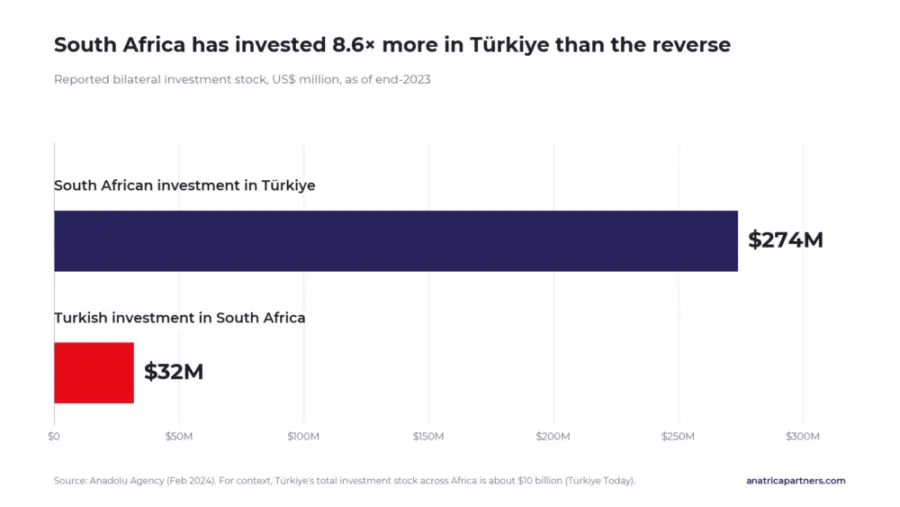
- Turkish investment in South Africa stands at around $32 million, a fraction of the corridor’s potential.
Anatrica Partners works one corridor: Türkiye and Southern Africa. Our people sit on both ends of it. Deal origination and structuring run out of Istanbul; execution, counterparties and regulators are handled in Johannesburg and Cape Town; senior leadership sits in Europe. Our M&A lead is South African and has spent two decades between Cape Town, London, Berlin and the continent’s boardrooms.
That combination is the whole point: we are not reading South Africa from a research terminal.
So when we see another market-entry deck telling Turkish investors that “South Africa has a strong mining sector,” we wince. Everyone knows that. Nobody tells you which door is open this quarter and which one closed eighteen months ago.
Here is what changed while most advisory material was being recycled.
What Changed in South Africa’s Investment Landscape
Load shedding has ended, but read the reason carefully
On 16 May 2026, Eskom marked one year without load shedding (TechCentral). That single fact has repriced industrial assets across the country.
But be careful what you conclude from it. Analysts point out that the grid was rescued as much by 15 GW of IPP capacity, private solar and battery installations, and the near-total closure of the ferrochrome and ferromanganese smelting industry as by Eskom itself (Daily Investor). Demand destruction is not the same as recovery, and we price client assets accordingly.
Mining is having its best run in a decade
Mineral sales from January to April 2026 reached R332 billion, up 36.5% year on year, on record prices across platinum, gold and rhodium, with the JSE precious metals index tripling in value (Mining Weekly).
But capital has become selective rather than enthusiastic. Money is flowing to infrastructure-proof projects such as Ivanhoe’s Platreef ramp-up, backed by $700 million in project financing, and Orion’s Prieska copper build, backed by a $250 million Glencore facility (ProjectsIQ). Cash-rich miners operating under a fixed capex ceiling is precisely the condition in which a supplier with better delivery times takes share. That is where we point our clients.
Rail has opened to private operators for the first time in a century
In May 2026, Transnet’s infrastructure manager signed operating agreements with 11 private train operating companies. RFPs are due this year for the Richards Bay dry bulk terminal concession, the Ngqura manganese export corridor and the Durban–Johannesburg container corridor, on a 25-year concession model (Polity; Daily Maverick).
In our view, this is the single biggest opening for Turkish contractors and rolling-stock manufacturers on the continent right now, and an area where our team spends much of its time.
The US export door has closed for automotive
South African vehicle exports to the US fell 83.2%, from 24,682 units in 2024 to 4,136 in 2025, after the 25% Section 232 tariff, a US national-security tariff on imported vehicles (SA Trade Desk). AGOA (the African Growth and Opportunity Act) renewal did not fix this: the extension provides certainty but does not restore the duty-free conditions that existed before the automotive tariffs.
Turkish investors being sold an automotive export story into America should change advisers.
Where We Advise Turkish Investors to Look
| Sector | Our view | Key risk |
|---|---|---|
| Mining consumables and services | Strong: Turkish suppliers win on cost and delivery | Customer concentration, long receivable days |
| Rail, ports and heavy logistics | Strongest current opening | Funding not fully solved |
| Energy: transmission and storage | Attractive | Merchant generation without bankable offtake |
| Agro-processing and cold chain | Selective | Seasonality, electricity tariffs |
| Automotive | Localisation only | US export volumes gone |
Mining consumables and services, not new mines
Pumps, valves, grinding media, filtration, mill liners, conveyors, and electrical and instrumentation maintenance. Turkish manufacturers are cost-competitive against European suppliers and faster than Asian ones on the Indian Ocean run.
What our diligence teams keep finding when the books open: revenue concentrated in two or three mines, receivable days north of 90, and a founder who is the customer relationship. We price that risk into the offer, or we advise the client to pass.
Rail, ports and heavy logistics
Transnet has committed R127 billion over five years to commercial infrastructure and PRASA R137 billion to passenger rail, within a National Rail Master Plan with a long-term investment need of about R2 trillion. At the same time, the rail infrastructure manager has asked Treasury for R26 billion to refurbish a network suffering from under-investment, theft and vandalism (Sunday Times).
We read that honestly for clients: the pipeline is real, the funding is not fully solved, and the winners will be investors who bring capital alongside capability rather than waiting for a fully funded tender.
Energy: transmission, not generation
Generation is no longer the bottleneck. The Transmission Development Plan requires R440 billion over the next decade and roughly 14,000 km of new lines, and the Minister has said plainly that neither the sovereign balance sheet nor Eskom’s can carry it (Daily Maverick).
Meanwhile, a grid surplus has triggered aggressive curtailment of renewable IPPs, creating a R2 billion compensation backlog, and virtual wheeling protocols fell sharply in the BLSA reform tracker after trading rules missed their April deadline (TechCentral).
Transmission EPC, substations, transformers, storage and behind-the-meter industrial solutions are where we would advise clients to deploy capital. Merchant generation without a bankable offtake, we would not.
Agro-processing and cold chain: selectively
The customer base is real. The trap is seasonality: a cold store running at 90% during harvest and 35% for the rest of the year is not the business the seller’s model describes.
NERSA approved an 8.76% tariff increase for Eskom’s direct customers from 1 April 2026 and 9.01% for municipal customers from July, with a further 8.83% already approved for 2027/28 (Engineering News). In refrigeration, that is a margin event, not a line item.
Automotive: localisation, not export
The US was South Africa’s third-largest automotive export destination at R28.7 billion in 2024, and that volume is gone for now. But the OEM plants remain, the industry accounted for 23.8% of South African manufacturing output in 2025, and local content policy is still the lever. Components, tooling and plant maintenance serving domestic and SADC-bound production is the sober play.
The Türkiye–South Africa Corridor Is Underweight, and That Is the Opportunity
Türkiye’s trade with Africa reached roughly $40 billion by the end of 2025, with an investment stock of about $10 billion, and Turkish contractors have completed 2,031 projects worth some $97 billion across the continent (Türkiye Today).
Yet total Turkish investment in South Africa has been reported at just $32 million, against South African investment into Türkiye of $274 million (Anadolu Agency). The most industrialised economy on the continent is receiving a rounding error of Turkish capital. Closing that gap is Anatrica’s entire mandate.
The precedents that work are already public. Arçelik owns Defy, which employs 2,700 people and exports to 16 SADC countries, and Aselsan runs its sub-Saharan operations through a South African subsidiary. That is the model we build toward: buy the platform, keep the people, export regionally. Not a greenfield factory and a hopeful five-year plan.
B-BBEE and the 2026 Transformation Fund: What Foreign Investors Need to Know
B-BBEE (Broad-Based Black Economic Empowerment) is South Africa’s framework for measuring and incentivising the participation of Black South Africans in the economy through ownership, management, skills development and procurement. A company’s scorecard directly affects its eligibility for public tenders and its attractiveness to private customers.
We take a position on this. B-BBEE is not a tax on foreign investors. It is the cost of participating in an economy where political liberation in 1994 was never accompanied by redistribution of the industrial base. Anatrica’s leadership includes people who sit on the board of the Anti-Apartheid Legacy Trust, who carries that history personally, and it shapes how we structure deals. Investors who treat transformation as a compliance nuisance lose tenders to investors who treat it as a partnership strategy. We have seen both outcomes.
What is changing now matters commercially. Draft amendments gazetted in January 2026 introduce a Transformation Fund, allowing businesses to contribute 3% of net profit after tax toward 20 scorecard points. Under draft Statement 103, the Fund becomes a recognised programme within the Equity Equivalent Investment Programme (EEIP), the mechanism that allows multinationals to earn ownership points without selling local equity (Transcend). This is directly relevant for Turkish groups whose global policy prevents selling local shares.
But it is still a draft, and it is contested. Verification specialists have argued that subsidiary legislation cannot impose a compulsory contribution of this nature without a primary Act of Parliament (SA Trade Desk). We structure for the current codes and track the amendments weekly.
Frequently Asked Questions
Is load shedding over in South Africa?
As of 16 May 2026, South Africa had gone one year without load shedding. However, the improvement is partly due to private generation and the closure of energy-intensive smelters, not solely to Eskom’s recovery.
What are the best sectors for Turkish investors in South Africa in 2026?
In our view: mining consumables and services, rail and port infrastructure, and electricity transmission and storage. Agro-processing is attractive selectively; automotive only for localised production.
Can Turkish companies invest in South Africa without selling local equity under B-BBEE?
Yes. Multinationals can use the Equity Equivalent Investment Programme (EEIP). Draft 2026 amendments would add a Transformation Fund within this framework, but they are not yet final.
How do Transnet’s private rail concessions work?
Transnet’s infrastructure manager signed agreements with 11 private train operators in May 2026. Major port and corridor concessions are being tendered on a 25-year model, with RFPs due in 2026.
Did AGOA renewal restore duty-free auto exports to the US?
No. The AGOA extension provides certainty, but the 25% Section 232 automotive tariff still applies, and exports to the US fell 83.2% between 2024 and 2025.
How to Start with Anatrica Partners
Bring us your sector, a budget range and an honest answer to one question: do you want to sell Turkish product into South Africa, manufacture here, or own a platform that exports into the region? Those three answers produce three completely different target lists.
Tell us which of the three you are, and Anatrica Partners will tell you what is actually available, including when the answer is “nothing worth your money this year.”
Tell us which of the three you are
About the author
Sasha Müller is Business Development and Cross Border M&A Manager at Anatrica Partners, Linkedin
Sources
- AGOA extension but Section 232 duty remains a major hurdle, SA Trade Desk
- Sharp rise in April mineral sales highlights importance of mining, Mining Weekly
- Where the mining money is going: investment trends 2026
- Creecy says RFPs for three big rail and port concessions on track for 2026, Polity
- Capital injection and rail reform transform SA’s logistics sector, Daily Maverick
- Transnet rail manager asks Treasury for R26bn, Sunday Times
- Load shedding is over, and that’s exposing a new energy crisis, TechCentral
- Truth about the end of load-shedding in South Africa, Daily Investor
- The R440bn private transmission gamble, Daily Maverick
- B-BBEE proposed amendments 2026, Transcend
- Leading verification agency criticises proposed B-BBEE amendments, SA Trade Desk
- Trade between Türkiye and South Africa booming, Anadolu Agency
- Türkiye–Africa trade reaches $40B, Türkiye Today
- Nersa approves higher electricity hikes for 2026/27, Engineering News