
In short: debt or equity financing?
- When you can see when and from which customers the revenue will come, a loan is a strong option, and the gains from growth stay with the existing shareholders.
- For investments with uncertain revenue timing, such as a new product or a new market, equity capital removes the pressure of repayments that start too early.
- An interest rate and an equity stake cannot be compared directly; both options should be tested against the same growth plan and the same scenarios.
- In many growth plans, the best outcome comes from a structure that combines debt and equity.
You have landed a large order, but your current production capacity is not enough. You need to buy a new machine, order raw materials and perhaps hire more staff. The customer, however, will pay months from now. Or you run an established business in your home market and want to grow abroad. This time you know roughly how much you will spend, but it is far less clear when sales will start.
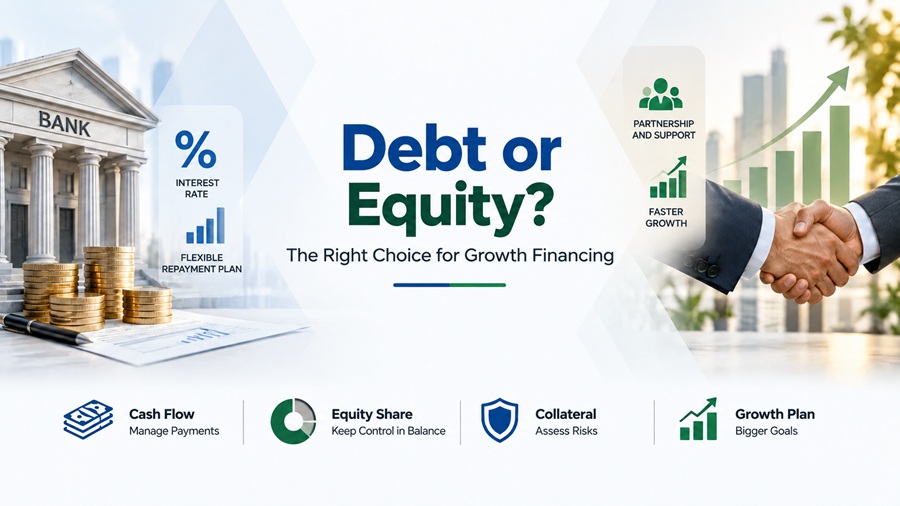
In both cases the same question comes up: should you finance growth with a loan, or bring an investor into the company?
If you borrow, you repay the debt with interest and keep the gains from the company’s growth with the existing shareholders. If you bring in an investor, you share part of the future profits and some decisions with your new partner. In return, you may have more time to wait for the investment to generate revenue. When choosing, the kind of partnership you want matters as much as the company’s capacity to repay.
How much money do you really need to grow?
The financing need for growth is not the purchase price of the investment, but the total cash gap the company has to cover until the investment starts generating regular revenue. You need to see this total before you start looking for funding. The price of a machine is not the total cost of going into production with it. After installation and trial runs, raw materials have to be bought, wages paid, and day-to-day costs keep running while you wait to collect from customers.
Expanding into a new country works in a similar way. Company set-up and office costs can be estimated. But it may take longer for the sales team to find customers, win the first orders and bring the business to a point where it covers its own costs. The budget has to provide for this period too.
That is why the financing need should be considered beyond the money spent until the investment is complete. Until the date the investment starts producing regular income, how much cash will come into the company and how much will go out? How much of this gap can the existing business cover? A loan taken without this calculation can leave the company short of cash even after the investment is finished.
Nor does the whole investment have to be made at once. Working with a distributor first in a new market, or adding production capacity in stages as orders come in, can reduce the money needed at the start. The effect on delivery times and costs must also be calculated. Starting smaller is an advantage in some businesses, while in others it makes the investment inefficient from the outset.
When does growing with a bank loan make sense?
A loan is a strong option when it is reasonably clear which revenue will cover the repayments. A company with regular customers, a known collection history and an existing business that already generates cash can take on the debt for a new investment with a more robust plan.
The production investments of a long-established Turkish textile group are an example of this kind of financing. On 16 December 2024, an international development finance institution announced a USD 50 million loan to the group. Of this, USD 30 million was to come from the institution’s own account and USD 20 million from a co-lending programme it manages. The intended uses included a new polyester plant, expanded yarn production capacity, textile recycling and rooftop solar installations. [1]
Here the loan was announced for clearly defined production and energy investments. Being in the same sector, however, does not mean another company can borrow the same amount. How much of the new capacity can be sold, customers’ payment terms and existing debt have to be assessed separately for each company. Because the announcement did not disclose the interest rate or repayment schedule, the cost of this transaction cannot be compared with another loan offer.
When you assess your own loan offer, looking only at the interest rate is not enough. Does the date of the first instalment match the date production starts? If principal repayments begin before the facility generates revenue, your existing business will have to cover them. Interest accrued during a grace period may also be added to the debt repaid later. The total repayment, including fees and other charges, should be visible.
Collateral is part of the decision as well. Which assets will be pledged, and will the shareholders be asked for personal guarantees? You should also consider whether the collateral you give today will make it harder to borrow for another investment later. The limit a bank approves can be higher than the amount the company can comfortably repay.
Why does a profitable company struggle to pay its loan instalments?
A profitable company struggles with repayments because profit and cash do not arrive at the same time: the income statement can show a profit while the bank account does not hold enough money. You have made the sale, but the customer has not yet paid. You have bought stock for new orders, paid taxes or had machines serviced. As the business grows, the money tied up in receivables and inventory can grow too.
This is why planning loan repayments by looking only at EBITDA, that is, earnings before interest, taxes, depreciation and amortisation, falls short. You need to see how much cash is left for debt service after taxes, necessary capital expenditure and the working capital needed to keep the business running. When sizing a new loan, the instalments on existing loans must be included in the plan.
One of the measures banks use is the debt service coverage ratio (DSCR). It shows the extent to which the earnings or cash available for debt service cover principal and interest payments. The calculation can vary by bank and by loan agreement, so it is worth finding out at the start which items your bank includes. [3]
Monthly cash flow matters as much as annual totals. Even if the company generates enough cash over the year, it may have to pay a large instalment in a month when collections are low. Businesses with seasonal sales in particular should set their repayment schedule accordingly.
When preparing the plan, also look at a case where sales fall short of expectations, collections are delayed or the investment is completed late. If in that case you would need a new loan to pay the instalments, the loan amount or maturity should be reconsidered from the start. If your revenue is in local currency and your debt is in dollars or euros, the same calculation should show how much a currency depreciation would increase the repayments.
When is bringing in an investor the better choice?
Bringing an investor into the company is the better choice for growth plans where the timing of revenue is uncertain. Developing a new product or entering a market where you have no customers yet is different from adding capacity for regular orders. The spending starts immediately, but it may take time for it to turn into sales. In such a plan, loan repayments that start early can force the company to abandon the investment or cut spending before the work is finished.
An investor who puts equity into the company aims to profit from the company’s growth rather than expecting instalments on fixed dates. For that, the investor has to believe in the growth plan, and the stake they receive has to meet their expected return. For the owner, it should be equally clear what is gained in exchange for the stake given away. Because the size of the stake depends on the value placed on the company today, entering negotiations with a defensible business valuation strengthens your negotiating position.
A Turkish-founded customer experience software company announced a USD 500 million funding round on 1 November 2024, led by a global growth equity investor. The announcement stated that the capital would go to AI and product development, growth in the United States, expanding the team and acquisition opportunities. Representatives of the investor joining the board of directors was also among the disclosed terms of the deal. [2]
This example shows how an investor partnership can be used for product development and international growth. With the partnership, the composition of the board also changes. Because the disclosed information did not include the stake given to the investor, we cannot calculate how much ownership the existing shareholders gave up or the total cost of the deal for them.
For your company, an investor’s contribution might be reaching new customers, building a team abroad, or drawing on their experience when acquiring a company. How this contribution will be delivered should be discussed during negotiations. You can look at which companies they have supported before, and in what areas. Customer connections that have not yet turned into a concrete agreement should not be written into the budget as firm sales.
What should you negotiate besides the size of the stake?
When bringing in an investor, management and consent rights, profit distribution, future capital needs and exit terms matter as much as the size of the stake. It is easy to assume that if you keep the majority of the company, you will keep full control of management. But an investor with a smaller stake may still require their consent for new borrowing, major spending or the sale of the company.
The effect of these rights on day-to-day operations should be discussed at the outset. You may want to take every major investment decision together. But if a routine purchase also needs approval, the business can slow down. It should be clear which decisions management can take on its own and which require shareholder approval.
How profits are used also matters. You may want an annual dividend, while the investor may expect all earnings to be reinvested in growth. The agreement should also address who contributes how much when the company needs money again, and how the stake of a shareholder who does not contribute will be affected.
Talk about how long the partnership is expected to last. An investment fund may want to sell its stake after a certain period, while you may plan to keep the company in the family for many years. Tag-along and drag-along situations, rights to buy the other partner’s shares and any buy-back obligations will shape the decisions you make later. If there are preferential rights that pay the investor first on a sale, the amount you receive may not be calculable simply from your ownership percentage.
Another important distinction is who receives the money. If the investor buys your existing shares, the purchase price goes to you. That transaction alone does not fund the company’s growth budget. A capital increase into the company and a sale of shares by existing shareholders can be combined in the same deal. In that case, it should be clear how much of the announced total investment will actually go into the company.
How do you compare debt and equity offers?
Debt and equity offers are compared by looking at where the company and the existing shareholders end up under the same growth plan and the same scenarios. A loan’s annual interest rate cannot be compared directly with the stake given to an investor. A loan is repaid on a set schedule. An investor, as long as they remain a shareholder, benefits from future earnings and, when they sell, from the value of the company. If the company grows strongly, the value of the stake given away today can also rise.
First determine how much money the company can actually use and when it will reach the account. Then look at where the company and the existing shareholders stand both when sales come in as expected and when things move more slowly.
| What to compare | With a loan | With an investor |
|---|---|---|
| Money available to the company | Loan amount remaining after fees | Capital injected directly into the company |
| If things are delayed | Ongoing instalments and a possible cash shortfall | Need for additional capital and shareholder contributions |
| Decision-making | Restrictions in the loan agreement | The new partner’s consent rights and role in management |
| What remains for the owner | Earnings after debt repayment and the value of the shares | Earnings shared with the new partner and the value of the remaining shares |
The comparison should use the same date and currency. Amounts to be received in different years can be expressed in present value terms. If the investor is expected to bring additional sales or cost advantages, that contribution should be shown separately. This makes clear which growth expectation the stake is being accepted on.
Can debt and equity be combined in a growth plan?
Yes; you do not have to meet the entire growth need from a single source. You can use a loan with suitable maturity or leasing for a machinery investment, while raising equity for the first years’ costs in a new market. What matters is that total debt service and the partnership terms are assessed within the same plan.
Before you start talking to a bank or an investor, the investment budget, monthly cash flow and the repayment schedule of existing debt should be ready. You should also know how much the shareholders can put in. This preparation helps you avoid borrowing more than you need, or giving away more equity than necessary to raise the funds. A financial review is a good starting point for seeing the company’s finances through this lens.
The decision should take into account the company’s ability to withstand a difficult period as much as the expected return on the investment. At Anatrica Partners, we assess companies’ growth plans, financing needs and investor partnership options within this framework.
Frequently Asked Questions
Is debt or equity cheaper for financing growth?
They cannot be compared directly. The cost of a loan is paid on a set schedule through interest, fees and the burden of collateral; the cost of an investor is the share of future earnings and company value given away. If the company grows fast, the cost of the stake given today rises; if growth is delayed, loan instalments weigh more heavily on the company. The right comparison looks at the value left to existing shareholders under both a good and a slow scenario of the same growth plan.
What is the debt service coverage ratio (DSCR)?
The debt service coverage ratio is the ratio of the earnings or cash a company can use for debt service to its principal and interest payments over the same period. A ratio below 1 means the cash the company generates is not enough to cover its instalments. Because banks may calculate the ratio using different items, you should find out your own bank’s definition at the start.
Does giving an investor a minority stake mean losing control?
Not always, but a majority stake alone does not guarantee full control either. A minority investor may ask for consent rights over new borrowing, major spending, dividends or the sale of the company. The agreement should state clearly which decisions are taken by management and which by the shareholders.
What is the difference between selling shares and a capital increase?
When existing shares are sold, the price goes to the selling shareholder and no money enters the company. In a capital increase, the investor’s money goes directly into the company and can be used in the growth budget. Because both can be combined in one deal, it should be made clear how much of the announced total will stay in the company.
What should you prepare before approaching a bank or an investor?
You should have the investment budget, a monthly cash flow running at least to the date the investment starts generating revenue, the repayment schedule of existing loans and the amount of capital shareholders can contribute. For investor discussions you also need a defensible assessment of the company’s value and good and slow scenarios for the growth plan.
Related content
Sources
[1] Press release by an international development finance institution on a USD 50 million capacity and sustainability loan to a Turkish textile group, 16 December 2024. View press release ↗
[2] Announcement by the growth equity investor that led the round, on a USD 500 million Series E funding round, 1 November 2024. View announcement ↗
[3] BDC, “What is the debt service coverage ratio (DSCR)?” Guide to assessing debt repayment capacity. Accessed 13 October 2026. View guide ↗
Last updated: 14 October 2026
This article is for general information only and does not constitute investment, credit, legal or tax advice. Financing decisions should be assessed based on company-specific data and circumstances.